
She is a fine artist.
And I mean that in all the ways.
She is a fine artist, working with oils, landscapes of vast horizons using tiny paintbrushes to create exact lifelike details of flowers with meticulously arranged, expertly shadowed raindrops. She is a fine artist, objectively talented and successful, commanding impressive sums of money at local galleries and street fairs. And she is fine. Fine. How are you? Fine. She says it a tad sharper than someone actually fine, but, sure. Fine.
She can’t paint. It’s been a while. It’s maddening. It has never happened. Never. And she’s irritable and angsty because she can’t get her head and her hands to be in the same place at the same time. She’s getting headaches. She can’t sleep. And nothing can be done. But now, it’s a professional emergency. She has a show in the spring that she is not ready for, and the more she tries to get ready the less ready she is. And every day she sits in her studio and holds those tiny flower brushes tighter and tighter and gets less and less ready.
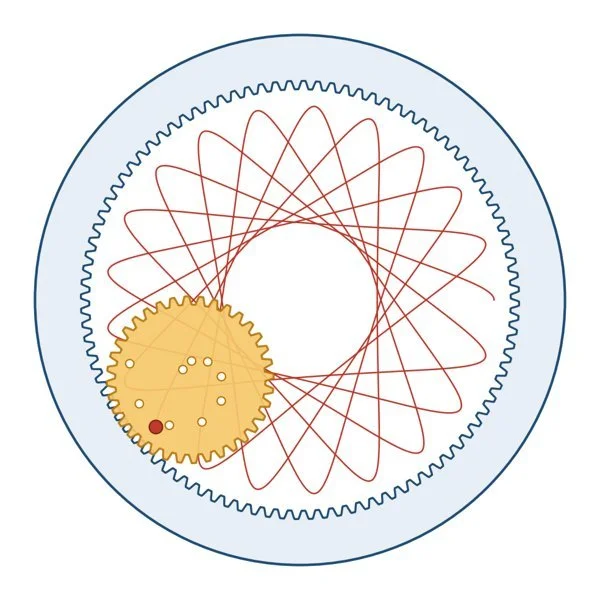
I ask how she got into art in the first place. This makes her dislike me and the question at the same time. Usually, she spins fanciful fictions about kindly art instructors baking cookies during lessons or encouraging grandmas with paint sets because it’s an origin story an artist is supposed to have. But really, “Remember that Spirograph thing from the ’70s? With the plastic turning disks you put your pen in to make those geometric designs?”
Gears fitting together, turning around and around, whirring along like a cat’s purr. It was loud and wild in her house when she was a kid. No classes, no gifting grandmas. The Spirograph made sense, mechanically balanced, soothing in its predictability. She would sit in her mom’s closet with the smell of perfume and make perfect circles, curvy rings. Whir, whir, whir.
I suggest a step back, in time, in space. Away from tiny brushes, tucked into a closet, lost in a Spirograph. “Fine,” she says. Not because she agrees but because she is aggravated enough to be open to suggestion. Because this is when we try weird things. And so, when those Voices join her there to tell her how stupid this is, how stupid she is, it’s easy to agree with them.
These are her defenses, following her, poking at her nervously, roused on purpose so we can talk about permission, so she can see where judgment pings in her body, so she can wonder who decides what’s stupid, name the fear on the other side of the door. It’s confronting, this work, creating space around the Voices. Good thing she can unwind with the Spirograph.
She makes her spiral circles, her symmetrical designs, with the pinpoint pen, even tinier than the brushes she uses for the tiny details in her paintings, the immaculate, tiny, tiny details. I point out the tiny-ness. She does not notice.
That pen only goes where it’s assigned, where it’s allowed. Obediently guided along the grid where it is imprisoned. Those are the rules of the Spirograph. That is what she likes about it, both now and then. The calm against the chaos, control in the closet. The pen with the sharp point, the paintbrushes with their satisfying precision.
But she pushed back on those Voices. Their alibis didn’t hold up under questioning. It made her wonder if this shame, these rules, were real. So, she pulled the pen from the plastic prison and made bigger, sloppier circles. Uncomfortable shapes that had mistakes. That weren’t perfect. That didn’t need a grid to create. Without the whir whir whir of the gears, but on her own terms, in her own hand. And the more she shed the judgment, the more she defied the rules, the more her art became about exploring, flow, and taking creative risks.
She is a fine artist. But now she paints murals on the sides of buildings as part of community projects, collaborates with other creators and, more importantly, uses different brushes. Did you know they make other sizes than super, ridiculously tiny? Because now that she is free to go outside the lines, she is free of the lines.
And isn’t that just fine?