
Shiny Drama
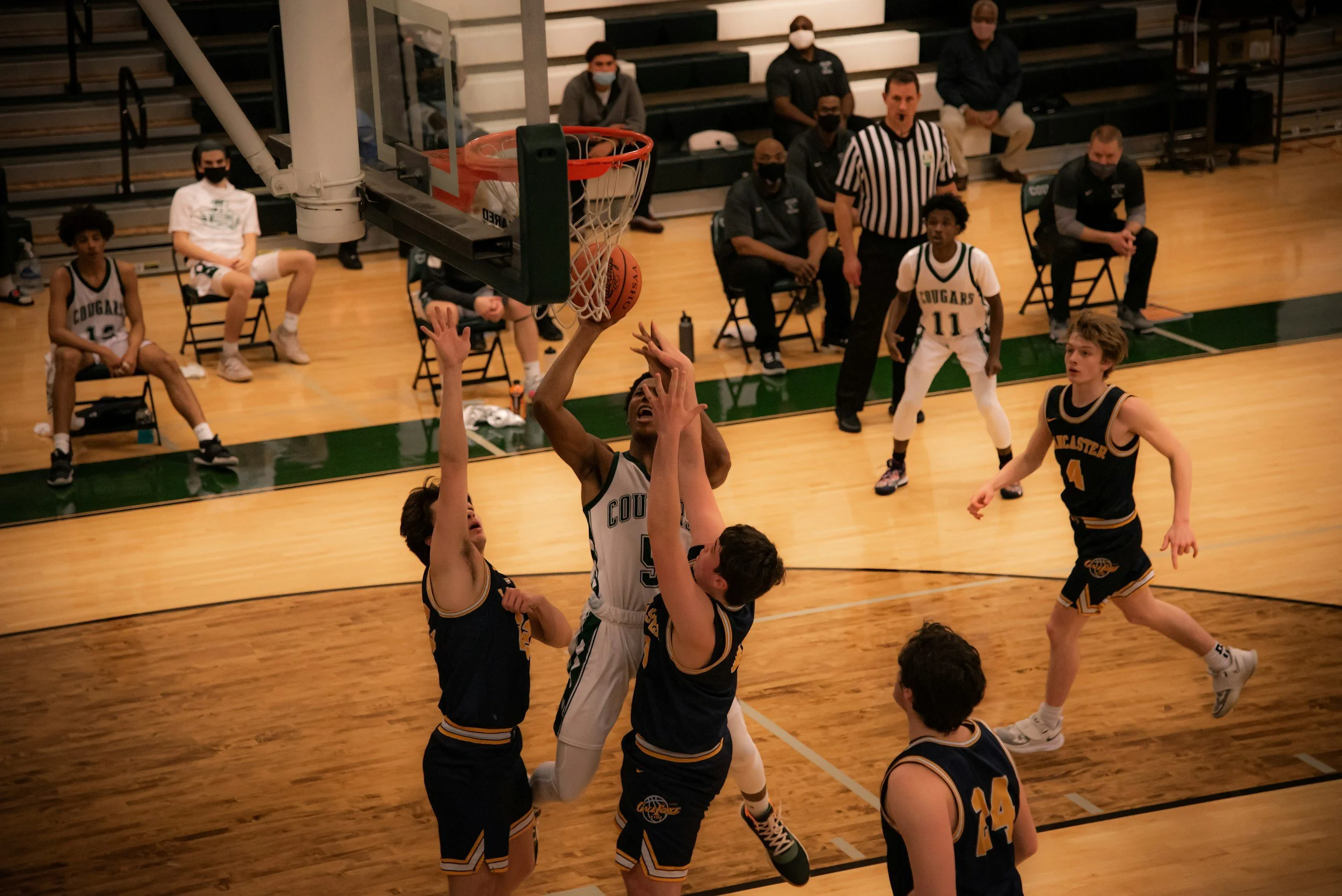
I am on the sidelines;
I have been tasked with taking pictures of The Game.
I send a weekly newsletter about writing, creativity, and making space between who we are and who we tell ourselves we are. This week was about the real-life stories unfolding all around us, all the time, especially in the messy imperfections. In fact, those are the best ones.
I don’t really care about The Game. I’m not even sure what game it is. Oh, I know it’s basketball; I’m not that checked out. I’ve played it myself, in between softball and getting hit in the face with red rubber dodgeballs in grammar school. There was even a momentary fever dream of lacrosse in college before the reality of dawn-adjacent weekend practice shut it down. I understand the game is happening, conceptually; I just can’t keep track of the specific stakes. Is this the big one? The tiebreaker one? The revenge one after the fifty-year losing streak? The one before the one where we find out who goes to State? What is the particular thing that I am supposed to live and die by today?
I also have a very low tolerance for suspense, and I have learned from experience to stop wondering aloud why everyone can’t just have fun. Aren’t they all winners, in a way? You know those movies when the clock has a second left, and someone's dog is going to die if they lose? This is torture for me; I prefer a shutout or a zero-zero tie score. Even better, a fire drill that gets everyone on a whole other plotline. Maybe there’s a Nancy Drew-type mystery to solve: The Secret of the Old Gym Locker.
It’s an important job, sideline camera person, and harder than it sounds. If you’re anything like me, you have been drafted, not volunteered, and you have to spend the whole time glancing back and forth through a viewfinder, capturing second-by-second action while witnessing it in real time, without getting nauseous. Because you will be questioned about the game itself while being held to an impossible standard of photography competency. Did you get the shot of that thing when she threw the thing into the other thing around the third thing? There is only one correct answer.
In general, I would put sports right around a Kardashian skin care routine in terms of overrated things I don't care about. And yet, this is often my de facto assignment in any scenario where there are players in some variation of uniform on some variation of field or court or parking lot, and I have enough of a relationship with the participants to be assigned a job. But sports photography? Well, that’s a different SPF-tinted moisturizer altogether.
The drama. The angst. The TALES these pictures tell. I have never seen a Kardashian rubbing soaps and differently shaded lotions on a Kardashian face and thought, "Wow, I bet there's a rich tapestry of backstory here." They are part of the posed, fake, infantilized, overshiny representations, the filtered, the altered and edited and tilted and dimmed and drained of interest. And maybe that's the point of this version of beauty, of perfection. The supermodeled and over-faked pictures are purposely packaged, easy to consume, like the people in them. Smoothed edges and blurred boundaries, pretty cardboard cutout humans against flattened soulless backgrounds, nonthreatening, unquestioning, undemanding.
But it’s precisely the raw imperfection that makes a picture, or a person, fascinating. The players in my photos shove one another, an elbow in a face, wearing expressions of exhaustion and rage, frozen in mid-air with wrinkled, jagged, uneven edges and lines. If you wanted to, you could write a comic book series using one scene as a prompt. You could find metaphor and meaning in the moments, the emotions, the snippets of dialogue dancing in action. Each player is an improv partner, yes-and-ing up and down a court at lightning speed.
Storyline is everywhere. Battles for conquest, love won and lost, goals made at the last possible second rage in and around us all the time. We choose when to engage, when to observe, when to incorporate another person’s idea of ideal into our personal standard. But in my pictures, messier is better, and in my house, shiny usually means someone spilled something sticky somewhere.
The good stuff is in the flaws, the misalignment, the soft focus. These are the parts we invest in as viewers of art, the teeth we lock into and relate with, and the parts we live as people, the struggle, the pain, the survival. The good fight storms as much as the bad one, and the opportunities to fold everyday art into our own are continuously presented to us; we don't always see them because we're nauseous from glancing back and forth through a viewfinder.