
Super Robot Chaos Who Knows Karate
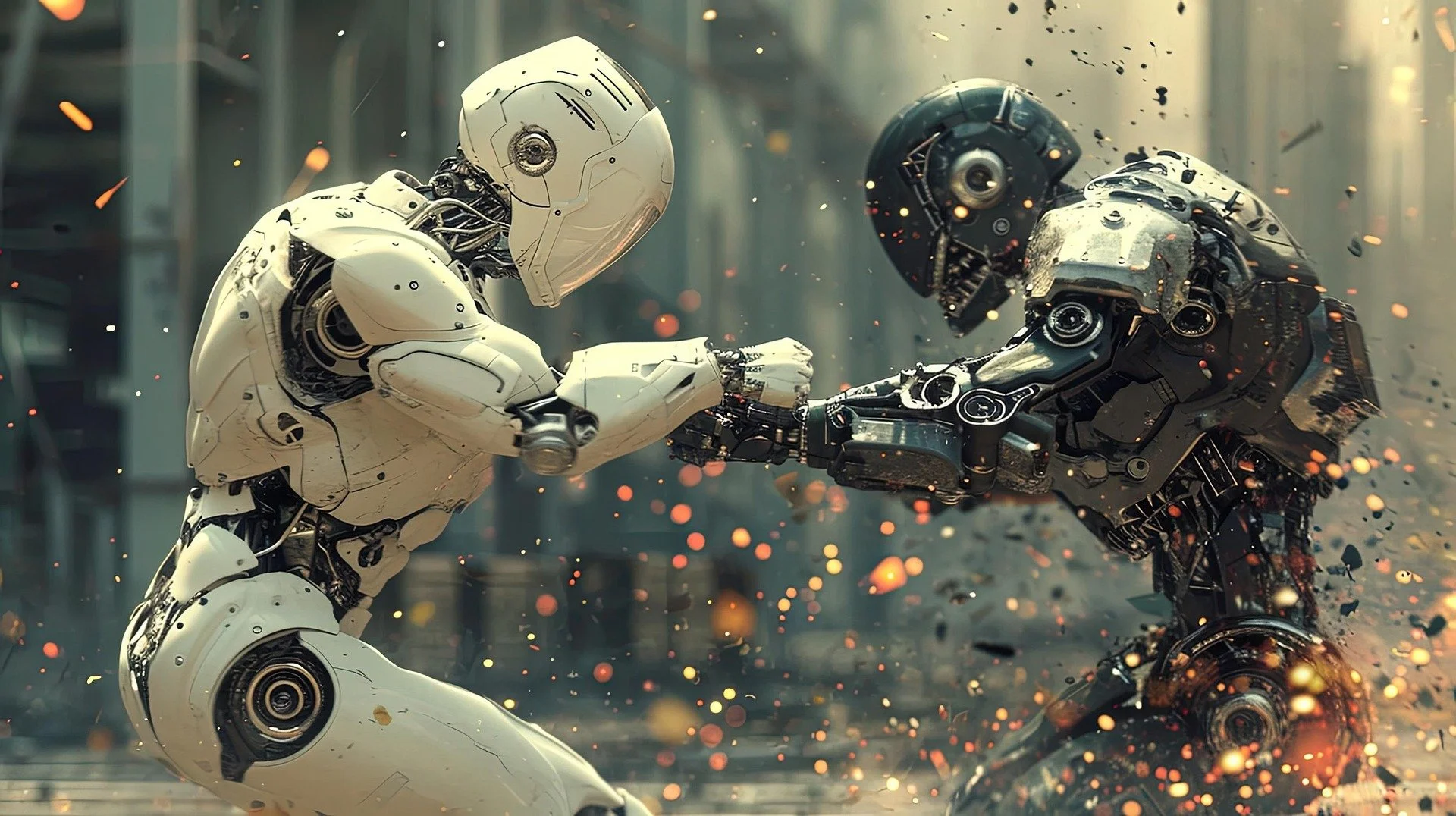
Super Robot Chaos Who Knows Karate doubles as both a fantastic sentence and the title of my five year-old's latest book.
It's a tale as old as time, really.
I send a weekly newsletter about writing, creativity, and making space between who we are and who we tell ourselves we are. This week was about the ease with with we can create and re-create on and on, as long as we don’t let the noise in our heads tell us our robots don’t have electric fire-breathing karate powers, or something stupid like that.
An evil electronic robot, Robo Speed Up, shoots lasers at Chaos who retaliates by breathing fire. Their battles are epic firecracker displays of light flashes and exploding body parts, accompanied by a cacophony of space crashing noises and mechanical squeaks. The vivid illustrations come to life, puppeteered by my son's narration.
Chaos is the good-guy, embodied by my son, wearing a robo-dragon suit. Don't bother pointing out how self-indulgent it is to make himself the hero of every story, he won't hear it. It's just bad writing, I say, as he shoots fire into my face. You can't just make up new super abilities on the spot.
"I have t-keestis!" he responds. I silently curse the Batman book we read the night before featuring Dr. Telekinesis, the Mind-Control Menace, as he makes me slap myself with my own hand. "Brain Shield!" thwarts my attempts to retaliate, his words suddenly making brain shields a thing.
Why does he not see the lines between reality and creativity? Why do his elaborate solutions overshadow my roadblocks? Why is there no convincing him that what he's doing is foolish or a waste of time?
Every re-telling of Super Robot Chaos Who Knows Karate is a little bigger than the last time, as if merely the act of repetition adds emotional investment to the robots, gas to the fire. The pictures are angled, jagged lines and shapes, more visceral than visual. You feel it along with my son as he passionately relives the victories and losses with sound effects and pantomime, but it's never the same story twice. It's as if the words don't matter at all. He wrote them, he trusts them. If he changes them, he still trusts them. Why wouldn't he? He's not easily fooled. He knows karate.
Sometimes the robots fight, sometimes they're on the same team, sometimes they switch mid-conflict to make a dangerous rescue in a magnanimous display of more-than-human decency, sometimes they both explode in fiery death. The only thing that remains constant is the razor-sharp drama and the illustrations that perfectly fit the ever-changing text. They bend around his feelings, they fall into line with his version of events, they know who's driving this bus as well as I do.
"See?" he gestures vaguely to a section of the page that was Chaos throwing robots in a volcano yesterday, "Robo Speed Up has lightning.” He is so confident that the drawing reflects his newest version of events that he hands it to me for proof. And dang it if Robo Speed Up doesn't have lightning. How can I argue with such a perfectly impenetrable circle of validation? And so when he doubles down on the attitude and asks me for a cupcake despite still having a ring of frosting around his mouth from the one he ingested six seconds ago I remember Super Robot's karate skills and slide one across the table.
There will always be someone who will tell you not to write a book about a Super Robot that knows karate, or at least a second since this one has already been written. And there will always be noise that says it doesn't make sense or a Robot can't shoot lasers or you already had a cupcake. And there will always be a reason why it is frivolous or silly or a waste of time. But here is a tiny genius using his writing to practice problem solving, and coping strategies, trying on different colors of the emotional rainbow all while fighting robots under claps of thunder and lightning. And he's showing you his evolving imagination, giving you a glimpse into this world he's creating as he creates it, even as he changes it, even as he grows it into something bigger and bigger.
And so, couldn't you use writing to create the world you want to see, to build the world you want inside before you go outside?
And if it changes as you change, well I guess the world would change too, wouldn't it?